
In the current digital environment characterized by competition, it is critical to choose the right social media marketing platforms that will be most effective for businesses. Good channel selection will not only enable companies to reach the customers who are most active but also to communicate in a meaningful way and to increase the brand’s visibility without wasting time or money.
A dependable digital marketing agency is, often, the organization’s partner, providing the necessary support in terms of making informed decisions based on audience behaviour and the strengths of different platforms.
Understanding Social Media in Relation to Business Goals
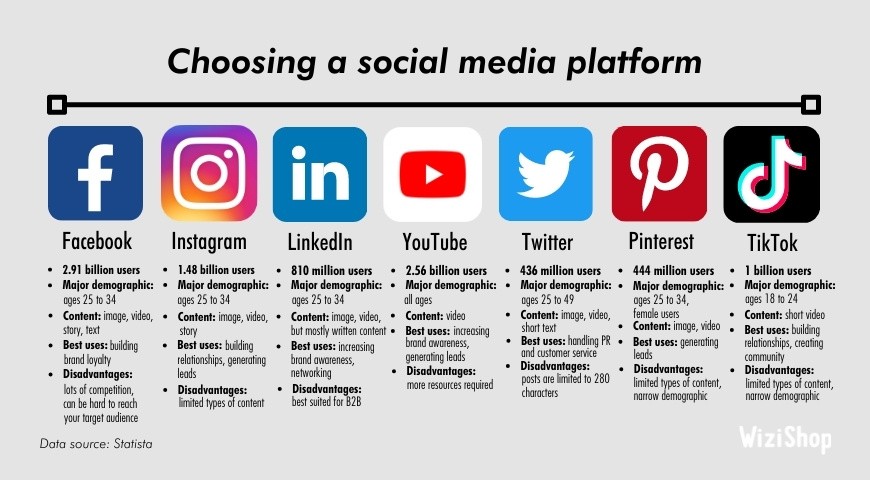
Image Text: Choosing a social media platform for your business
Every single business has its own goals: raising brand awareness, generating leads, providing customer service, or making sales. The platforms are not equally effective at serving all purposes. Facebook and Instagram, for instance, have a wide reach and excellent ad targeting, while LinkedIn is the best for B2B networking and TikTok attracts viewers with its creative and short content.
A recent survey of the industry indicated that over 90% of businesses use social media, but only a small percentage customize their choice of platforms to their specific goals. This discrepancy often leads to underperforming campaigns and resource waste.
Match Platforms to Your Audience
It’s critical to know where the audience is and spends their time. The professionals-targeted marketing campaign can be the most successful on LinkedIn, while the product with strong visuals can show up on Instagram or Pinterest where its audience is found. Also, statistics say that the youngest groups of people are taking it up increasingly with TikTok and YouTube. hus, these platforms become the points of action for the brands that are focusing on Gen Z or Millennial consumers. A successful platform strategy considers not only the audience members but also their content consumption preferences.
Strengths and Limitations of Major Platforms
Every platform has its own strengths:
- Facebook gives access to a large audience and provides ad targeting with great details.
- Instagram is all about visuals, which makes it the perfect place for lifestyle brands.
- LinkedIn is where professional and B2B communicational messages find their support.
- TikTok and YouTube provide very engaging experiences through the creative video content.
The alignment of these strengths with corporate goals helps determine even more effective solutions for the allocation of time and budget resources.
How Experiments Inform Decisions
A typical structured approach consists of trying out different platforms with smaller campaigns and then analyzing the results. Metrics like engagement rate, conversion rate, and cost per click show the places where a strategy is appealing, sometimes in surprising ways.
Real-time performance tracking with tools and analytics dashboards is essential for businesses to quickly switch if one of the platforms does not perform well.
Conclusion: Smart Platform Selection for Business Growth
Choosing the right social media platforms for marketing is not a matter of being everywhere; it is a matter of being where your audience is most willing to listen. Businesses can create stronger ties and benefit from better results by using a combination of platform insights, audience behaviours, and campaign data.
Even if you are a start-up or a well-established brand, teaming up with a skilled digital marketing agency can help you choose the right platform and strategy with clarity and confidence.