
Search used to be largely about earning a place on a results page. In 2026, a potential customer may still click a traditional listing, but they may also receive an answer directly from Google’s AI experiences or another generative platform.
That shift has brought three terms into the same conversation: SEO, AEO, and GEO. Each has a different focus, but they overlap and depend on many of the same search fundamentals. Knowing where each fits can help businesses adapt without treating them as three separate strategies.
SEO Builds the Foundation for Being Found
Search Engine Optimization, or SEO, focuses on making webpages discoverable and competitive in traditional search results through useful content, search intent, crawlability, internal linking, technical performance, and authority. Those foundations also matter beyond traditional results because Google’s generative search features still rely on its core Search ranking and quality systems.
For businesses, SEO remains the base layer. A weak website does not suddenly become stronger simply because the search interface changes.
AEO Makes Your Information Easier to Use as an Answer
Answer Engine Optimization focuses on how clearly a page addresses the questions people are asking. Direct explanations, descriptive headings, relevant details, and logical content structure make information easier for users and answer-driven systems to understand. These practices can also support generative search, which is why AEO and GEO often overlap.
A service page, for example, becomes more useful when it clearly explains what the service does, who it is for, how it works, and what someone should consider before choosing it.
GEO Looks Beyond the Traditional Search Result
Generative Engine Optimization focuses on visibility within AI-generated responses and conversational search experiences. It considers whether content can be understood and surfaced when a generative system builds an answer.
For businesses, that puts greater value on accurate information, firsthand expertise, original insights, useful examples, and enough context to address a subject properly. Content should contribute something meaningful rather than repeat information already available across the web.
There is no shortcut that guarantees inclusion in an AI-generated response. GEO is better viewed as an extension of strong SEO and AEO practices, not a replacement for them.
Businesses Need One Search Strategy, Not Three Separate Ones
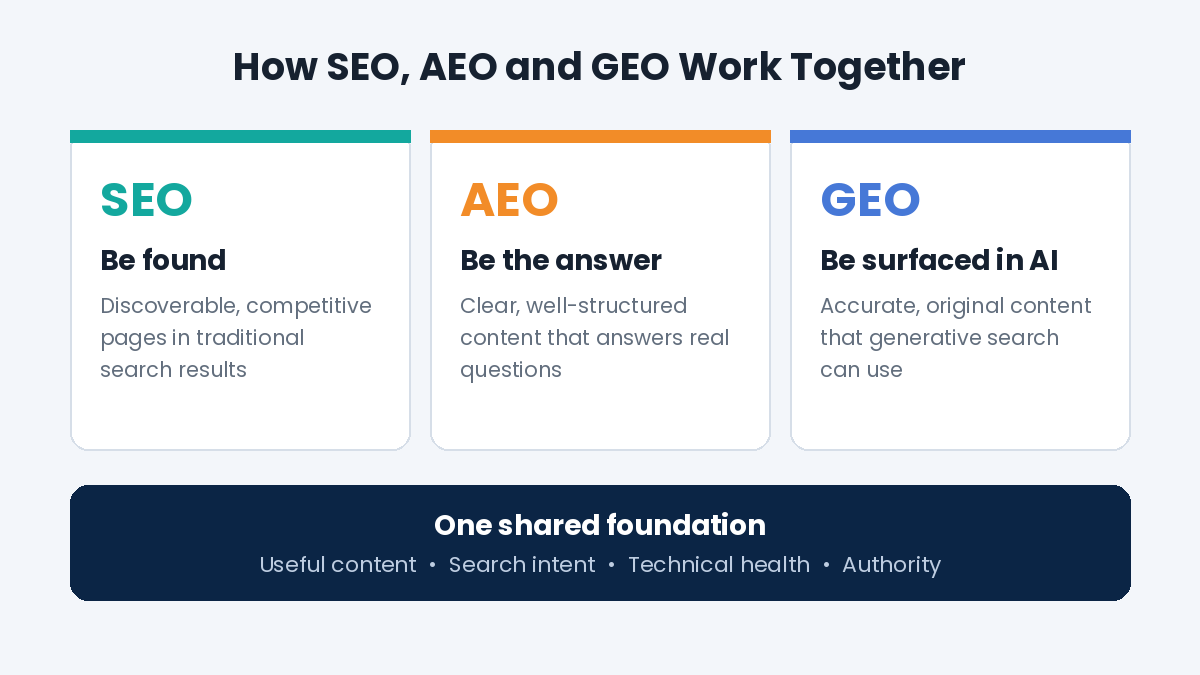
Put simply, SEO helps content become discoverable, AEO makes information easier to use as an answer, and GEO considers how that information may surface within generative responses. The methods overlap, so businesses do not need three disconnected strategies.
At CRM Digital Inc., we combine SEO and Answer Engine Optimization to help businesses strengthen visibility across traditional and AI-powered search. Contact us to build a search strategy around the content, technical foundations, and authority needed to compete in 2026.
Frequently Asked Questions
What is the difference between SEO, AEO, and GEO?
SEO helps webpages get discovered and compete in traditional search results. AEO structures content so it clearly answers the questions people ask. GEO focuses on how that information can be understood and surfaced within AI-generated responses. All three rely on many of the same search fundamentals, which is why they work best as one strategy.
Does my business still need SEO if customers are using AI search?
Yes. SEO remains the base layer of search visibility. Google’s generative search features still rely on its core Search ranking and quality systems, so a website with weak content, poor crawlability, or limited authority is unlikely to perform better simply because the search interface has changed.
Can any strategy guarantee my business appears in AI-generated answers?
No. There is no shortcut that guarantees inclusion in an AI-generated response. The most reliable approach is to publish accurate, well-structured content backed by firsthand expertise and original insights, while maintaining the technical and authority foundations that strong SEO already requires.