

When someone in Houston searches for “plumber near me” or “dentist in Clear Lake,” Google decides in a fraction of a second which three businesses appear in the map, and which ones never get seen. Local SEO is the work of making sure your business is one of them.
This guide explains how local SEO works for Houston and Bay Area businesses, what actually moves rankings, and how each part fits together. It’s written for owners of service businesses, clinics, contractors, law firms, restaurants, and retailers who know they should be showing up on Google but aren’t sure where to start. Each section links to a deeper article if you want the full detail on that topic.
What is local SEO?
Local SEO is the process of improving a business’s visibility in location-based Google searches, including the Google Map Pack, Google Maps, and local organic results. It covers your Google Business Profile, website, reviews, citations, and local content, so Google can confidently show your business to nearby customers.
Traditional SEO helps a website rank for a topic. Local SEO helps a business rank for a topic in a place. For a Houston business, that difference matters. A homeowner in League City searching for “AC repair” doesn’t want a national guide to air conditioners. They want a company that can be at their door this afternoon.
Google treats these searches differently. It shows a map with three businesses, often called the Map Pack or Local Pack, above or alongside the regular organic results. Those three spots receive a large share of clicks, calls, and direction requests, which is why local SEO has become one of the most valuable marketing channels for businesses that serve a defined area.
Why does local SEO matter for Houston businesses?
Houston is one of the largest and most spread-out metro areas in the country. A search for the same service can return very different results in Downtown, Pasadena, Webster, or Friendswood because Google weighs the searcher’s location heavily. That means a business can rank well a few miles from its office and be invisible in the next suburb over.
Local SEO matters here for three practical reasons:
-
Local searches carry strong intent. People searching for a service with a location, or with “near me,” are usually ready to call, book, or visit.
-
Competition is dense. In most Houston service categories, dozens of businesses compete for the same three Map Pack positions.
-
Customers judge you before they click. Your star rating, review count, photos, and hours are visible right in the search results, so your profile often makes the first impression, not your website.
For small businesses, local SEO is also one of the few channels where steady effort compounds. Reviews, citations, content, and links keep working long after the work is done, unlike ads that stop the moment the budget runs out.
How does Google rank local businesses?
Google ranks local results using three main factors: relevance, distance, and prominence. Relevance is how well your business matches the search. Distance is how close you are to the searcher or the location in the query. Prominence is how well known and trusted your business is, based on reviews, links, citations, and overall online presence.
Google has publicly confirmed these three factors, and nearly every local SEO tactic supports one of them:
| Factor | What it means | What improves it |
|---|---|---|
| Relevance | How closely your business matches the search | Accurate categories, services, website content, and keywords |
| Distance | How close your business is to the searcher | Your verified address or service area, and location content |
| Prominence | How trusted and well-known your business is | Reviews, ratings, links, citations, and brand mentions |
You can’t change distance much, since your address is where it is. But you can strongly influence relevance and prominence, and that’s where local SEO work focuses. The sections below cover the most important parts of that work.
How to rank in the Google Map Pack in Houston
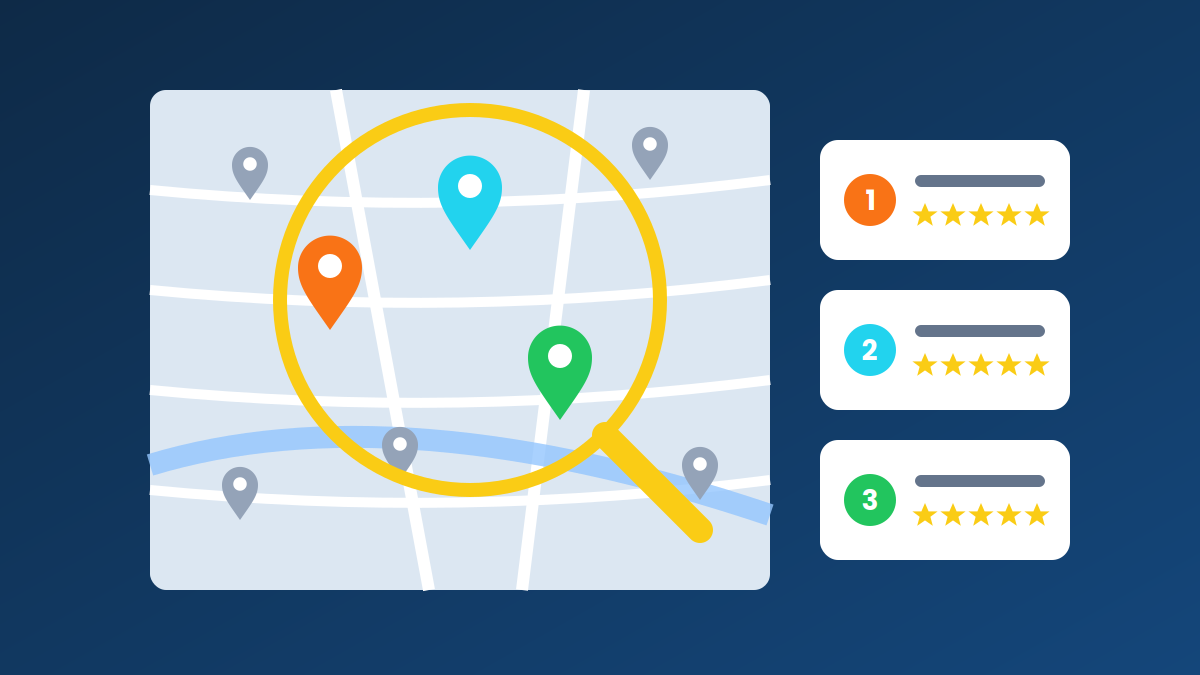
To rank in the Google Map Pack, a Houston business needs a fully optimized Google Business Profile, accurate and consistent business information across the web, a steady flow of genuine reviews, and a website with clear local signals. Google combines these to decide which three businesses appear for each search.
The Map Pack is the most valuable real estate in local search. It appears above organic results for most service searches, and it shows your rating, hours, and a call button without the searcher ever visiting your site.
Ranking there starts with your Google Business Profile, especially your primary category, which is one of the strongest relevance signals. From there, Google looks for consistency: your business name, address, and phone number should match on your website, profile, and directories such as Yelp, Apple Maps, and Bing Places. Reviews then signal prominence, and your website confirms what you do and where you do it.
Because Houston is so large, your Map Pack visibility will vary by neighborhood. A business in Webster may rank first in Clear Lake but tenth in Pearland. Tracking rankings across a grid of locations shows where you’re strong and where you need more local signals.
For a step-by-step breakdown, read our guide on how to rank in the Google Map Pack in Houston.
Google Business Profile optimization: The foundation of local SEO
Your Google Business Profile is the single most important local SEO asset you control. A fully optimized profile has the right primary and secondary categories, accurate hours, a complete services list, a keyword-relevant description, regular photos and posts, and owner responses to reviews. Incomplete profiles rarely rank in the Map Pack.
Many Houston businesses claim their profile once and never touch it again. That leaves easy wins on the table. Google rewards profiles that are complete, accurate and active; customers also trust them more.
The essentials include:
-
Categories: choose the primary category that best matches your main service, then add relevant secondary categories.
-
Business details: keep your name, address, phone number, website link, and hours accurate, including holiday hours.
-
Services and description: list every service you offer and write a clear description of what you do and where.
-
Photos and posts: upload real photos of your team, location and work, and publish updates regularly.
-
Reviews and messages: respond to reviews and enable messaging if you can answer promptly.
Just as important is what not to do. Adding keywords to your business name, listing a virtual office, or creating duplicate profiles can get a listing suspended.
Use our Google Business Profile optimization checklist to review your profile item by item.
How Google reviews affect local rankings

Google reviews affect local rankings because they are a key prominence signal. The number of reviews, your average rating, how recently reviews arrive, and the words customers use all help Google judge how trusted and relevant your business is. Reviews also strongly influence whether searchers click and call.
Reviews do two jobs at once. For Google, they’re evidence that real customers use and value your business. For customers, they’re often the deciding factor between you and the business listed next to you.
A few things matter more than most owners expect:
-
Recency: a business with 40 reviews this year often looks more active than one with 200 reviews from five years ago.
-
Review content: when customers naturally mention a service or neighborhood, such as “fast water heater repair in Friendswood,” it reinforces what you do and where.
-
Owner responses: replying to every review, positive or negative, shows Google and customers that the business is engaged.
The safest way to grow reviews is a simple, consistent process: ask every customer shortly after the job, and send a direct link to your review form. Google’s policies prohibit buying reviews, offering incentives for reviews, or asking only happy customers to leave them.
Learn more in our article on how Google reviews affect local rankings.
Service area pages: How to do them right
Service area pages target a specific city or neighborhood you serve, such as League City or Pasadena. Done well, they give Google and customers useful local information. Done badly, with the same text and only the city name swapped, they’re treated as thin or duplicate content and rarely rank.
Many Houston businesses serve customers well beyond their office address. Service area pages help your website rank in those places, and they support your Map Pack visibility by giving Google more local relevance signals.
What separates a strong service area page from a weak one is genuine local detail. Good pages include:
-
Projects or customers you’ve served in that area, with photos where possible
-
Reviews from customers in that city or neighborhood
-
Local specifics, such as common problems, housing types, permits or service times
-
The services you offer there, and a clear way to contact you
-
A short FAQ that answers questions people in that area actually ask
It’s better to publish five strong pages for the areas you serve most than 50 near-identical pages for every suburb. Start with the locations that bring the most revenue, and expand as you gather local examples and reviews.
Read the full guide on service area pages and how to do them right.
What results can you expect from local SEO in 90 days?
In the first 90 days of local SEO, most businesses see foundation fixes completed, a more complete Google Business Profile, early ranking movement for less competitive local searches, and more profile views and actions. Strong rankings for competitive Houston searches usually take longer, often three to six months or more.
Local SEO is not instant, but it’s also not a mystery. A realistic 90-day plan usually looks like this:
-
Month 1: Foundations. Audit and fix the Google Business Profile, correct business information across key directories, fix technical website issues, and set up tracking.
-
Month 2: Relevance. Improve service and location pages, add local content, and start a consistent review request process.
-
Month 3: Momentum. Publish regular profile posts and photos, build local citations and links, and review early ranking and lead data.
The speed of results depends on your starting point, your category, and your competition. A roofing company in a crowded Houston market will move more slowly than a specialist in a niche service. What matters most in the first 90 days is that the right foundations are in place and the leading indicators, such as profile views, calls, and direction requests, are moving in the right direction.
For a month-by-month breakdown, read what results you can expect from local SEO in 90 days.
How AI Overviews are changing local search for Houston businesses

AI Overviews are Google’s AI-generated summaries that now appear above many search results. For local searches, they can summarize businesses, compare options, and answer questions before a user clicks anything. Businesses with clear, consistent information, strong reviews, and helpful website content are the most likely to be mentioned.
Search is changing quickly. Alongside the Map Pack, Google’s AI Overviews and AI tools such as ChatGPT and Perplexity are increasingly answering local questions like “Who’s the best family dentist in Clear Lake?” or “How much does a roof inspection cost in Houston?”
These systems draw on the same signals that drive local SEO, plus a few more:
-
Consistent business information across your website, Google Business Profile, and directories
-
Reviews and ratings, including what customers say about specific services
-
Clear, answer-first content on your website that directly answers common questions
-
Structured data, such as LocalBusiness and FAQ schema, that helps search engines understand your business
The good news is that the work that improves your Map Pack rankings also improves your chances of being mentioned in AI answers. The businesses that get left behind are those with thin websites, inconsistent details, and few recent reviews.
Read more about how AI Overviews are changing local search for Houston businesses.
What else supports local SEO?
Beyond your profile, reviews and location pages, a few other signals help Google trust your business:
-
Citations and NAP consistency
Citations are online mentions of your business name, address, and phone number, known as NAP. Listings on Yelp, Apple Maps, Bing Places, Facebook, the BBB, and industry directories all count. When these details match everywhere, Google is more confident about your business. When they conflict, such as an old phone number or a former address, that confidence drops.
-
Local links
Links from other Houston websites are strong prominence signals. Good sources include local chambers of commerce, the Bay Area Houston Economic Partnership, sponsorships, local news coverage, community organizations, and partner businesses.
-
Technical SEO and site speed
Your website still needs to be fast, mobile-friendly, secure, and easy for Google to crawl. A slow or broken site undermines everything else, especially for mobile searchers who want to call you right away.
-
LocalBusiness schema
Schema markup is code that tells search engines your business name, address, phone, hours, and services in a structured way. It doesn’t guarantee rankings, but it removes guesswork and supports both traditional and AI search.
What local SEO mistakes do Houston businesses make most often?
The most common local SEO mistakes are an incomplete or outdated Google Business Profile, inconsistent business details across directories, too few recent reviews, and location pages that copy the same text for every city. Each one weakens the signals Google uses to decide who appears in the Map Pack.
We see the same issues again and again when auditing Houston and Bay Area businesses:
-
Choosing the wrong primary category. A broad category such as “Contractor” instead of “Roofing contractor” makes it harder to rank for the service people actually search for.
-
Old details left online. A previous phone number or address on Yelp, Facebook, or an industry directory sends mixed signals to Google.
-
Letting reviews go quiet. Many businesses collect a burst of reviews and then stop asking, so their profile looks less active than competitors’.
-
Linking the profile to the homepage only. For multi-location businesses, each profile should link to its own location page.
-
Ignoring tracking. Without call tracking and Google Analytics 4 conversions, it’s impossible to tell whether local search is bringing in customers.
Fixing these is often the fastest way to see early gains, because they remove problems that hold back everything else.
How do you measure local SEO success?
Local SEO success is measured by business outcomes, not rankings alone. The most useful metrics are calls, direction requests, and website clicks from your Google Business Profile, form submissions and calls from organic search, Map Pack rankings across your service area, and the number and rating of your reviews.
A good local SEO report should show:
-
Google Business Profile views, calls, direction requests, and website clicks
-
Leads from organic search, tracked as calls and form submissions in Google Analytics 4
-
Map Pack rankings for priority keywords across several Houston locations
-
Review growth, average rating, and response rate
-
Progress on the work itself, such as pages published, citations fixed, and links earned
If your current reports show only a list of keyword positions, you’re missing the part that matters most: whether local search is bringing in customers.
Should you do local SEO yourself or hire an agency?
Many Houston business owners can handle the basics themselves, such as claiming their profile, keeping hours accurate, and asking for reviews. The harder parts are technical fixes, location content, citation cleanup, link building, and ongoing tracking, which take time and specialist tools.
An agency makes sense when you’re in a competitive category, serve several areas, or simply don’t have the hours to stay consistent. When comparing agencies, ask how they report on leads, which work is included each month, and whether they follow Google’s guidelines. Avoid anyone who promises guaranteed number one rankings, since no one controls Google’s results.
A good local SEO partner should start with an audit of your profile, website, reviews, and competitors, explain the priorities in plain language, and agree on the metrics that define success before any work begins. You should always own your Google Business Profile, website, and analytics accounts, even if an agency manages them for you.
Get a free local SEO audit for your Houston business
CRM Digital Inc.helps Houston and Bay Area businesses get found on Google Maps and in local search, from Google Business Profile optimization and service area pages to reviews, citations and reporting that shows real leads.
Not sure where your business stands? Request a free local SEO audit and we’ll show you how your Google Business Profile, website and reviews compare with your top local competitors, along with the first changes to make. Prefer to talk it through? Call us at (346) 289-5992 or learn more about our SEO services.
Frequently asked questions
1. How long does local SEO take to work in Houston?
Most businesses see early improvements, such as more profile views and better rankings for less competitive searches, within the first two to three months. Strong positions for competitive Houston searches usually take three to six months or more, depending on your category, competition and starting point.
2. Do I need a physical office in Houston to rank locally?
You need a real address to verify a Google Business Profile, but service-area businesses can hide their address and list the areas they serve instead. Virtual offices and mailbox addresses break Google’s guidelines and can get a profile suspended.
3. How many Google reviews do I need to rank in the Map Pack?
There’s no fixed number. What matters is how you compare with the businesses ranking for the same searches. Aim to match or exceed your top competitors’ review count over time, while keeping reviews recent and responding to every one.
4. Is local SEO worth it for a small business?
For most service businesses that rely on local customers, yes. Local searches have strong buying intent, and the Map Pack drives calls and visits directly. Unlike ads, the results of local SEO keep working after the work is done.